Flemish Secessionists Will Again Seek a Vote to Politically Empower Their Own.
The Hawaiian sovereignty movement (Hawaiian: ke ea Hawaiʻi), is a grassroots political and cultural campaign to plant an autonomous or independent nation or kingdom of Hawaii due to want for sovereignty, self-determination, and self-governance.[1] [ii] Some groups also advocate for some course of redress from the United States for the 1893 overthrow of Queen Lili'uokalani, and for what is described equally a prolonged military machine occupation beginning with the 1898 annexation. The movement more often than not views both the overthrow and annexation every bit illegal.[three] [four] Palmyra Atoll and Sikaiana were annexed by the Kingdom in the 1860s and are regarded by the movement equally being nether illegal occupation forth with the Hawaiian Islands.[v] [vi] The Apology Resolution passed past the United States Congress in 1993 acknowledged that the overthrow of the Kingdom of Hawaii in 1893 was an illegal deed.[7]
Sovereignty advocates have attributed problems plaguing native communities including homelessness, poverty, economical marginalization, and the erosion of native traditions to the lack of native governance and political self-determination.[8] [9] They take pursued their agenda through educational initiatives and legislative actions. Forth with protests throughout the islands, at the capitol (Honolulu) itself as well every bit the places and locations held as sacred to Hawaiian culture, sovereignty activists take challenged U.s. forces and law.[x]
History [edit]
Coinciding with other 1960s and 1970s indigenous activist movements, the Hawaiian sovereignty movement was spearheaded past Native Hawaiian activist organizations and individuals who were disquisitional of issues affecting modern Hawaii, including urbanization and commercial development of the islands, corruption in the Hawaiian Homelands program, and the cribbing of native burying grounds and other sacred spaces.[xi] During the 1980s, the movement gained cultural and political traction and native resistance grew in response to urbanization and native disenfranchisement. Local and federal legislation provided some protection for native communities but did piffling to quell expanding commercial development.[nine]
In 1993, a joint congressional resolution apologized for the 1893 overthrow of the Hawaiian monarchy, and said that the overthrow was illegal.[11] [seven] In 2000, the Akaka Beak was proposed, which provided a procedure for Us federal recognition of Native Hawaiians and gave indigenous Hawaiians some command over country and natural resource negotiations. However, the bill was opposed by sovereignty groups because of its provisions that legitimized illegal land transfers, and was criticized by a 2006 U.S. Committee on Civil Rights report (which was later reversed in 2018)[12] for the effect it would have on non-ethnic Hawaiian populations.[13] A 2005 Grassroot Institute poll found the bulk of Hawaiian residents opposed the Akaka Bill.[14]
Background [edit]
The ancestors of Native Hawaiians may have arrived in the Hawaiian Islands around 350CE, from other areas of Polynesia.[fifteen] By the time Captain Cook arrived, Hawaii had a well-established civilisation with a population estimated to be between 400,000 and 900,000 people.[fifteen] Starting in 1795 and completed by 1810, Kamehameha I conquered the entire archipelago and formed the unified Kingdom of Hawaii. In the first ane hundred years of contact with Western civilization, due to disease and war, the Hawaiian population dropped by 90 percent, to simply 53,900 people in 1876.[15] American missionaries would arrive in 1820 and assume bang-up ability and influence.[xv] Despite formal recognition of the Kingdom of Hawaii past the United states[16] and other world powers, the kingdom was overthrown offset January 17, 1893, with a putsch orchestrated past, mostly, Americans within the kingdom'due south legislature, with aid from the United States military.[xv] [17]
The Blount Report is the popular proper noun given to the role of the 1893 Us Firm of Representatives Foreign Relations Committee Report regarding the overthrow of the Kingdom of Hawaii. The written report was conducted by U.S. Commissioner James H. Blount, appointed by U.S. President Grover Cleveland to investigate the events surrounding the January 1893 insurrection. This report provides the first evidence that officially identifies the U.s.' complicity in the overthrow of the regime of the Kingdom of Hawaii.[18] Blount concluded that U.Due south. Minister to Hawaii John L. Stevens had, in fact, carried out unauthorized partisan activities that included the landing of U.S. Marines under a false or exaggerated pretext to support anti-royalist conspirators; the study went on to find that these deportment were instrumental to the success of the revolution and that the revolution was carried out against the wishes of a bulk of the population of the Hawaiian Kingdom and/or its Royalty.[nineteen]

On December 14, 1893, Albert Willis arrived unannounced in Honolulu aboard the USRC Corwin, bringing with him an apprehension of an American invasion in lodge to restore the monarchy, which became known as the Black Week. Willis was the successor to James Blount equally United states Minister to Hawaii. With the hysteria of a armed services assault, he staged a mock invasion with the USS Adams and USS Philadelphia, directing their guns toward the capital. He also ordered rear admiral John Irwin to organize a landing functioning using troops on the 2 American ships, which were joined by the Japanese Naniwa and the British HMS Champion. On January eleven, 1894, Willis revealed the invasion to be a hoax.[twenty] [21] Later on the arrival of the Corwin, the provisional government and citizens of Hawaii were set up to rush to arms if necessary, but information technology was widely believed that Willis' threat of strength was a bluff.[22] [23]
On December 16, the British Government minister to Hawaii was given permission to country marines from HMS Champion for the protection of British interests; the send's captain predicted that the Queen and Sovereign ruler (Liliuokalani) would be restored by the U.South. military.[22] [23] In a November 1893 meeting with Willis, Liliuokalani indicated that she wanted the revolutionaries punished and their property confiscated, despite Willis' desire for her to grant amnesty to her enemies.[24] In a December xix, 1893, meeting with the leaders of the provisional government, Willis presented a letter of the alphabet written by Liliuokalani, in which she agreed to grant amnesty to the revolutionaries if she was restored as queen. During the conference, Willis told the conditional government to surrender to Liliuokalani and allow Hawaii to render to its previous condition, but the leader of the provisional government, President Sanford Dole, refused to comply with his demands, claiming that he was not subject area to the authority of the United States.[23] [25] [26]
The Blount Report was followed in 1894 past the Morgan Report, which contradicted Blount's study past final that all participants except for Queen Lili'uokalani were "not guilty".[27] : 648 U.S. Secretary of State Walter Q. Gresham announced on January 10, 1894, that the settlement of the situation in Hawaii would be left up to Congress, following Willis' unsatisfactory progress. Cleveland said that Willis had carried out the letter of his directions, rather than their spirit.[22] Domestic response to Willis' and Cleveland'due south efforts was largely negative. The New York Herald wrote, "If Government minister Willis has not already been ordered to quit meddling in Hawaiian affairs and mind his own business, no time should be lost in giving him emphatic instructions to that consequence." The Autonomous New York World wrote: "Is it non high time to end the business of interference with the domestic diplomacy of foreign nations? Hawaii is 2000 miles from our nearest declension. Allow it alone." The Democratic New York Lord's day said: "Mr. Cleveland lacks ... the first essential qualification of a referee or arbitrator." The Republican New York Tribune called Willis' trip a "forlorn and humiliating failure to carry out Mr. Cleveland's outrageous project." The Republican New York Recorder wrote, "The idea of sending out a minister accredited to the President of a new republic, having him present his credentials to that President and address him as 'Great and Good Friend,' and so deliberately ready to work to organize a conspiracy to overthrow his Government and re-institute the authority of the deposed Queen, is repugnant to every man who holds American accolade and justice in any sort of respect." The Democratic New York Times was one of the few New York newspapers that defended Cleveland's decisions, saying that "Mr. Willis discharged his duty as he understood information technology."[22]
Following the overthrow, in 1894 the Conditional Government of Hawaii became the Democracy of Hawaii, and in 1898 the Republic of Hawaii was annexed past the United States in the Newlands Resolution, becoming the Territory of Hawaii.[28] [29] The territory was and so given a territorial regime in an Organic Act in 1900. While there was much opposition to the overthrow of the Kingdom of Hawaii and many attempts to restore the kingdom, information technology became a territory of the US in 1898, without any input from Native Hawaiians.[15] Hawaii became a US state on March xviii, 1959, following a referendum in which at least 93% of voters canonical of statehood. Past then, most voters were not Native Hawaiian. The 1959 referendum did non have an choice for independence from the United States. Following Hawaii's access equally a state, the Un removed Hawaii from its list of non-self-governing territories (a list of territories that are bailiwick to the decolonization process).[30]
The The states constitution recognizes Native American tribes as domestic, dependent nations with inherent rights of self-decision through the Us authorities as a trust responsibleness, which was extended to include Eskimos, Aleuts and Native Alaskans with the passing of the Alaska Native Claims Settlement Act. Through enactment of 183 federal laws over 90 years, the US has entered into an implicit—rather than explicit—trust relationship that does non requite formal recognition of a sovereign people having the right of self-determination. Without an explicit police force, Native Hawaiians may not be eligible for entitlements, funds and benefits afforded to other US indigenous peoples.[31] Native Hawaiians are recognized past the US regime through legislation with a unique status.[15] Proposals have been made to treat Native Hawaiians as a tribe similar to Native Americans; opponents to the tribal arroyo contend that it is not a legitimate path to nationhood.[32]
Historical groups [edit]
![[icon]](https://upload.wikimedia.org/wikipedia/commons/thumb/1/1c/Wiki_letter_w_cropped.svg/20px-Wiki_letter_w_cropped.svg.png) | This section needs expansion. You can help by adding to information technology. (January 2016) |

- Regal Order of Kamehameha I
- The Royal Order of Kamehameha I is a Knightly Gild established by His Majesty, Kamehameha V (Lot Kapuaiwa Kalanikapuapaikalaninui Ali'iolani Kalanimakua) in 1865, to promote and defend the sovereignty of the Kingdom of Hawaiʻi. Established by the 1864 Constitution, the Social club of Kamehameha I is the first guild of its kind in Hawaii. After Lot Kapuāiwa took the throne as King Kamehameha V, he established, by special decree,[33] the Order of Kamehameha I on April 11, 1865, named to laurels his granddad Kamehameha I,[34] [ self-published source? ] founder of the Kingdom of Hawaii and the House of Kamehameha. Its purpose is to promote and defend the sovereignty of the Kingdom of Hawaii. Until the reign of Kalakaua, this would be the only Order instituted.[35]
- The Royal Gild of Kamehameha I continues its work in observance and preservation of some native Hawaiian rituals and customs established by the leaders of the Kingdom of Hawaiʻi. It is often consulted by the U.South. government, State of Hawaiʻi and the various county governments of Hawaiʻi in native Hawaiian-sensitive rites performed at land functions.[36]
- Hui Kālai'āina
- This organization existed before the overthrow to support a new constitution and was based in Honolulu, Oahu.[37]
- Hui Hawaii Aloha 'Āina
- A highly organized grouping formed in 1883 from the various islands with a proper noun that reflected Hawaiian cultural beliefs.[37]
- Liberal Patriotic Association
- The Liberal Patriotic Association was a insubordinate group formed by Robert William Wilcox, to overturn the Bayonet Constitution. The faction was financed by Chinese businessmen who lost rights under the 1887 Constitution. The move initiated what became known as the Wilcox Rebellion of 1889, ending in failure with vii expressionless and 70 captured.[ commendation needed ]

Opposition to the overthrow and looting included Hui Aloha 'Āina or the Hawaiian Patriotic League.
- Dwelling house Dominion Party of Hawaii
- Following the annexation of Hawaii, Wilcox formed the Home Rule Party of Hawaii on June 6, 1900. The Political party was mostly more than radical than the Democratic Political party of Hawaii. They were able to dominate the Territorial Legislature between 1900 and 1902. But due to their radical and farthermost philosophy of Hawaiian nationalism, infighting was prominent. This, in addition to their refusal to work with other parties, meant that they were unable to pass any legislation. Following the election of 1902 they steadily declined until they disbanded in 1912.[ citation needed ]
- Autonomous Party of Hawaii
- The Democratic Party of Hawaii was established April 30, 1900, by John H. Wilson, John South. McGrew, Charles J. McCarthy, David Kawānanakoa and Delbert Metzger. The Political party was generally more than businesslike than the radical Dwelling house Rule Political party, which included gaining sponsorship from the American Democratic Party. They attempted to bring representation to Native Hawaiians in the territorial government and effectively lobbied to set aside 200,000 acres (810 kmtwo) under the Hawaiian Homes Commission Act of 1920 for Hawaiians.[ citation needed ]
Sovereignty and cultural rights organizations [edit]
ALOHA [edit]
The Aboriginal Lands of Hawaiian Ancestry (ALOHA) and the Principality of Aloha[38] were organized former in the tardily 1960s or '70s when the Native Alaskan and American Indian activism was beginning. Native Hawaiians began organizing groups based on their own national interests such as ceded lands, costless education, reparations payments, gratis housing, reform of the Hawaiian Homelands Human action and development within the islands.[39] Co-ordinate to Budnick,[twoscore] the grouping was established by Louisa Rice in 1969. Charles Kauluwehi Maxwell claims that it was organized in the summertime of 1972.[41]
ALOHA sought reparations for Native Hawaiians by hiring a former US congressman to write a bill that, while not ratified, did spawn a congressional study. The report was only immune 6 months and was accused of relying on biased data from a historian hired by the territorial government that overthrew the kingdom as well every bit U.s. Navy historians. The commission assigned to the study recommended against reparations.[42] : 61
Ka Lāhui [edit]
Ka Lāhui Hawaiʻi was formed in 1987 as a local grassroots initiative for Hawaiian sovereignty. Mililani Trask was the first leader of the organisation.[43] Trask was elected the first kia'aina (governor) of Ka Lahui.[44] The organization has a constitution, elected offices and representatives for each isle.[45] The group supports U.s. Federal recognition and its independence from the U.s.a.[46] : 38 and supports inclusion of Native Hawaiians in federal Indian policy.[42] : 62 The organization is considered the largest sovereignty movement grouping, claiming a membership of 21,000 in 1997. One of its goals is to reclaim ceded lands. In 1993, the group led ten,000 people on a march to the Iolani Palace on the 100th anniversary of the overthrow of Queen Liliuokalani.[47]
Ka Lāhui and many sovereignty groups oppose the Native Hawaiian Government Reorganization Act of 2009 (known as the "Akaka Bill") proposed past Senator Daniel Akaka that begins the process of federal recognition of a Native Hawaiian regime, where the US State Department would have government-to-government relations with the US.[48] The group believes that there are concerns with the process and version of the nib.[49] Although Ka Lāhui may oppose the Akaka Bill, its founding member, Mililani Trask, supported the original Akaka Bill and was a member of a group that crafted the original beak.[50] Trask has been critical of the neb's twenty-yr limitation on all claims against the United states of america, stating: "We would not exist able to address the illegal overthrow, address the alienation of trust problems." and "We're looking at a terrible history.... That history needs to be remedied."[51] The organization was a part of UNPO from 1993 through 2012.[52]
Ka Pākaukau [edit]
Kekuni Blaisdell, leader of the system,[48] is a medical doctor and Founding Chair of the Department of Medicine at the University of Hawai'i John Burns School of Medicine, who advocates for the independence of Hawaii.[53] The group began in the late 1980s every bit the Pā Kaukau coalition forth with Blaisdell and others to supply information that could support the sovereignty and independence movement.[54]
Blaisdell and the 12 groups that comprise the Ka Pākaukau, believe in a "nation-within-a-nation" concept as a start forrard to independence and are willing to negotiate with the President of the Usa as "representatives of our nation as co-equals."[55]
In 1993, Blaisdell convened Ka Ho'okolokolonui Kanaka Maoli, the "People's International Tribunal", which brought indigenous leaders from around the world to Hawaii to put the U.S. Government on trial for the theft of Hawaii's sovereignty, and other related violations of international law. The tribunal institute the U.South. guilty, and published its findings in a lengthy certificate filed with the U.N. Committees on Human Rights and Ethnic Affairs.[56]
Nation of Hawaiʻi [edit]
The Nation of Hawaiʻi is the oldest Hawaiian independence system.[57] Information technology is headed by Dennis Puʻuhonua "Bumpy" Kanahele,[58] [ self-published source? ] who is the group's spokesperson and Caput of State.[59] In contrast to other independence organizations which lean to the restoration of the monarchy, information technology advocates a republican regime.
In 1989 the group occupied the area surrounding the Makapuʻu lighthouse on Oʻahu. In 1993 its members occupied Kaupo Embankment, near Makapuʻu. Kanahele was a master leader of the occupation, and was the leader of the group overall. Dennis Puʻuhonua Kanahele is a descendant of Kamehameha I, eleven generations removed[threescore] and is the spokesperson for the organization and the "Caput of State" of the Nation of Hawaiʻi. The group ceased their occupation in substitution for the render of ceded lands in the next community of Waimānalo, where they established a village, cultural center, and puʻuhonua (place of refuge).[lx]
Kanahele made headlines again in 1995 when his group gave sanctuary to Nathan Brown, a Native Hawaiian activist who had refused to pay federal taxes in protest against the US presence in Hawaii. Kanahele was arrested, bedevilled, and sentenced to viii months in federal prison, along with a probation menses in which he was barred from the puʻuhonua and from participation in his sovereignty efforts.[58]
In 2015, Bumpy portrayed himself in the picture show Aloha filmed on location in Hawaii at Puʻuhonua o Waimanalo.[61] This was followed past a 2017 episode of Hawaii 5-0 entitled "Ka Laina Ma Ke One (Line in the Sand)".[62]
Nou Ke Akua Ke Aupuni O Hawaiʻi – The Kingdom of Hawaiʻi [edit]
Edmund Keliʻi Silva Jr., whom many[ who? ] in Hawaii recognize as male monarch, appear a $2.5bn (£1.6bn) plan to reorganize and restore the Kingdom of Hawaiʻi and published the Constitution of the Kingdom of Hawaii on Oct 27, 2003.[63] According to Eugene Bai of Russia Direct, In late September 2015 at the Moscow President Hotel in Russia, a ii meg rubles briefing was organized by a Kremlin endowment for war machine-patriotic activities set up by Russian President Vladimir Putin. The briefing was for separatist movements around the globe including Northern Ireland's nationalist republican party. Four days before the conference, Lanny Sinkin, representing an "Contained Sovereign Land of Hawaii" and Edmund Keliʻi Silva Jr. received his invitation and funding for the trip to Moscow. He and the Hawaiian contingency were well received.[64]
Mauna Kea Anaina Hou [edit]
Kealoha Pisciotta is a former systems specialist for the joint British-Dutch-Canadian telescope,[65] [66] who became concerned that a stone family shrine she had congenital for her grandmother and family unit, years before, had been removed and found at a dump.[66] She is one of several people who sued to end the structure of the 30 Meter Telescope[67] and is also managing director of Mauna Kea Anaina Hou.[68] Mauna Kea Anaina Hou ("People who pray for the mountain",[69] [ cocky-published source? ]) and its sister grouping, Mauna Kea Hui, are indigenous, Native Hawaiian, cultural groups with environmental concerns located in the country of Hawaii. The group is described as "Native Hawaiian organization comprised of cultural and lineal descendants, and traditional, spiritual and religious practitioners of the sacred traditions of Mauna Kea."
The issue of cultural rights on the mountain was the focus of the documentary: Mauna Kea — Temple Under Siege which aired on PBS in 2006 and featured Kealoha Pisciotta.[66] The Hawaii State Constitution guarantees the religious and cultural rights of Native Hawaiians.[70] Many of the state of Hawaii's laws can exist traced back to Kingdom of Hawaii constabulary. Hawaiʻi Revised Statute § 1-i codifies Hawaiian custom and gives deference to native traditions.[71] In the early 1970s, managers of Mauna Kea did not seem to pay much attention to complaints of Native Hawaiians about the sacred nature of the mountain. Mauna Kea Anaina Hou, the Royal Society of Kamehameha I and the Sierra Lodge, united their opposition to the Keck'southward proposal of calculation half dozen addition outrigger telescopes.[72]
Poka Laenui [edit]
Hayden Burgess, an chaser who goes by the Hawaiian proper noun Poka Laenui, heads the Institute for the Advancement of Hawaiian Affairs.[73] Laenui argues that considering of the four international treaties with the United States regime (1826, 1849, 1875, and 1883) the "U.S. armed invasion and overthrow" of the Hawaiian monarchy, a "friendly government," was illegal in both American and international jurisprudence.[74]
Protect Kahoolawe Ohana (PKO) [edit]
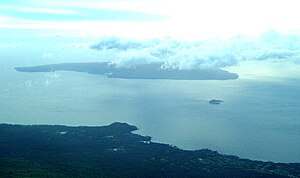
In 1976, Walter Ritte and the group Protect Kahoolawe Ohana (PKO) filed adjust in U.S. Federal Court to stop the Navy's use of Kahoolawe for battery grooming, to require compliance with a number of new environmental laws and to ensure protection of cultural resources on the island. In 1977, the U.S. District Court for the District of Hawaii immune the Navy's employ of this isle to continue, simply the Court directed the Navy to prepare an environmental impact statement and to consummate an inventory of celebrated sites on the island.
The attempt to regain Kahoʻolawe from the U.S. Navy inspired a new political awareness and activism within the Hawaiian community.[75] Charles Maxwell and other community leaders began to plan a coordinated endeavour to land on the island, which was still under Navy control. The effort for the "showtime landing" began in Waikapu (Maui) on January 5, 1976. Over l people from across the Hawaiian islands, including a range of cultural leaders, gathered on Maui with the goal of "invading" Kahoolawe on January half-dozen, 1976. The engagement was selected because of its association with the United States' bicentennial ceremony.
As the larger grouping headed towards the isle, they were intercepted by military crafts. "The Kahoʻolawe Nine" continued and successfully landed on the island. They were Ritte, Emmett Aluli, George Helm, Gail Kawaipuna Prejean, Stephen Chiliad. Morse, Kimo Aluli, Aunty Ellen Miles, Ian Lind, and Karla Villalba of the Puyallup/Muckleshoot tribe (Washington State).[76] The effort to retake Kahoʻolawe would somewhen claims the lives of George Captain and Kimo Mitchell. In an effort to reach Kahoʻolawe, Helm and Mitchell (who were likewise accompanied by Baton Mitchell, no relation) ran into astringent weather and were unable to reach the island. Despite all-encompassing rescue and recovery efforts, they were never recovered. Ritte became a leader in the Hawaiian community, coordinating customs efforts including for water rights, opposition to state development, and the protection of marine animals[77] and body of water resources.[77] He now leads the effort to create country legislation requiring the labeling of genetically modified organisms in Hawaiʻi.[78]
Hawaiian Kingdom [edit]
David Keanu Sai and Kamana Beamer are two Hawaiian scholars whose works apply international law to argue for the rights of a Hawaiian Kingdom existing today and telephone call for an end to U.s.a. occupation of the islands.[46] : 394 Trained equally a U.S. military officeholder, Sai uses the title of chairman of the Interim Council of Regency of the Hawaiian Kingdom system.[79] Sai has done all-encompassing historical research, especially on the treaties between Hawaii and other nations, and on military occupation and the laws of war. Dr. Keanu Sai teaches Hawaiian Studies at Windward Community College.[80]
Sai claimed to represent the Hawaiian Kingdom in a case, Larsen v. Hawaiian Kingdom, brought before the World Court's Permanent Courtroom of Arbitration at the Hague in the Netherlands in December 2000.[81] [82] Although the arbitration was agreed to by Lance Paul Larsen and David Keanu Sai, with Larsen suing Sai for not protecting his rights as a Hawaiian Kingdom subject, his bodily goal was to take U.Due south. rule in Hawaii declared in alienation of mutual treaty obligations and international law. The arbiters of the case affirmed that there was no dispute they could decide upon, considering the United States was not a party to the mediation. As stated in the award from the mediation panel, "in the absence of the United states, the Tribunal tin neither decide that Hawaii is non part of the USA, nor proceed on the supposition that it is not. To take either form would be to condone a principle which goes to heart of the arbitral role in international law."[83]
In an arbitration hearing before the Permanent Courtroom of Mediation in December 2000, the Hawaiian flag was raised at the aforementioned height at and aslope other countries.[84] Nonetheless, the court accepts arbitration from private entities and a hearing before the court does not equal international recognition.[85]
Hawaiian Kingdom Authorities [edit]
About 70 members of one separatist grouping, chosen "Hawaiian Kingdom Government", and challenge roughly 1,000 members in 2008, chained the gates and blocked the entrance to ʻIolani Palace for about ii hours, disrupting tours on April 30, 2008.[86] The incident ended without violence or arrests.[87] Led by Mahealani Kahau, who has taken the championship of "Queen", and Jessica Wright, who has taken the title of "Princess", they have been meeting each 24-hour interval to conduct regime business and demand sovereignty for Hawaii and the restoration of the monarchy. They negotiated rights to be on the lawn of the grounds during regular hours normally open to the public by applying for a public-assembly let. Kahau said that "protest" and "sovereignty group" mischaracterize the group, merely that it is a seat of government.[88]
Hawaiian sovereignty activists and advocates [edit]

Cultural practitioner Joshua Lanakila Mangauil, along with Kahoʻokahi Kanuha and Hawaiian sovereignty supporters block the access road to Mauna Kea in October 2014, demonstrating against the building of the 30 Meter Telescope
- Owana Salazar, claimant to the throne of Hawaiʻi and member of the Business firm of Laʻanui
- Francis Boyle, professor of international law, University of Illinois College of Law and Consultant on Independence, Hawaiian Sovereignty Advisory Commission, State of Hawaii (1993)[89]
- Kaiulani Edens-Huff, a KKCR DJ, was suspended (among two other native Hawaiian KKCR DJs) for an on-air atmospherics with some other Hawaiian not-native DJ, sparking accusation of racism and protests and an arrest of one of the protestors outside the station.[xc] [91]
- George Helm (musician) and Kimo Mitchell (both d. 1977)
- Israel Kamakawiwoʻole (musician; d. 1997)
- Bumpy Kanahele Hawaiian nationalist leader, militant activist, and head of the Nation of Hawaiʻi
- Kahoʻokahi Kanuha, activist and "protector" of Mauna Kea in opposition to the structure of the Thirty Meter Telescope. Kanuha defended himself after arrests in the native Hawaiian language or ʻōlelo Hawaiʻi. He chanted his genealogy going back to Umi-a-Liloa and his protection of the mountain and was found not guilty on January xvi, 2016.[92]
- Joshua Lanakila Mangauil, Hawaiian cultural practitioner and leader of the international movement to protect Mauna Kea.[93]
- Kawaipuna Prejean (d. 1992) was a Hawaiian nationalist, activist and abet for the Hawaiian sovereignty move. Prejean was founder of the Hawaiian Coalition of Native Claims, at present known as the Native Hawaiian Legal Corporation.[94]
- Noenoe K. Silva, political scientist, University of Hawaii at Manoa[95]
- Haunani-Kay Trask
- Mililani Trask
- Leon Siu, Hawaiian musician and activist. In 2017 he became the get-go Hawaiian to be nominated for the Nobel Peace Prize.[96]
- Keanu Sai, a professor in international law who championed the 2001 Lance Larsen v Hawaiian Kingdom instance at the Permanent Court of Arbitration.[97]
- Sudden Rush, Hawaiian rap/hip hop (na mele paleoleo) musical grouping[98]
Reaction [edit]
In 1993, the Land of Hawaiʻi adopted Human action 359 "to acknowledge and recognize the unique status the native Hawaiian people bear to the Land of Hawaii and to the United states and to facilitate the efforts of native Hawaiians to be governed by an indigenous sovereign nation of their own choosing." The human activity created the Hawaiian Sovereignty Informational Committee to provide guidance with: "(i) Conducting special elections related to this Act; (2) Apportioning voting districts; (3) Establishing the eligibility of convention delegates; (4) Conducting educational activities for Hawaiian voters, a voter registration drive, and inquiry activities in preparation for the convention; (5) Establishing the size and composition of the convention delegation; and (6) Establishing the dates for the special election. Act 200 amended Human activity 359 establishing the Hawaiʻi Sovereignty Elections Council".[99]
Those that were involved with the Advisory Committee forums believed that the question of the political status for Native Hawaiians has become a difficult issue to deal with. Yet, in 2000 a panel of the committee stated that Native Hawaiians take maintained a unique community. Federal and state programs have been designated to ameliorate weather condition for Native Hawaiians, including health, educational, employment and training, children's services, conservation programs, fish and wild animals protection, agricultural programs, and native linguistic communication immersion programs.[99] The Hawaiian Homes Commission (HHC) was created by Congress in 1921. The Part of Hawaiian Affairs (OHA) was the result of a 1978 amendment to the Hawaiʻi Land Constitution and controls over a billion dollars from the Ceded Lands Trust, spending millions to accost the needs of Native Hawaiians. Mahealani Kamauʻu, executive director of the Native Hawaiian Legal Corporation states that only in the last 25 years that Native Hawaiians "had a modicum of political empowerment and been able to practise direct responsibility for their own affairs, that progress has been made in and so many areas". These programs accept opposition and critics that believe they are non effective and managed badly.[99]
The Amends Bill and the Akaka Bill [edit]
In the past decades, the growing frustration of Native Hawaiians over Hawaiian homelands every bit well as the 100th anniversary of the overthrow, pushed the Hawaiian sovereignty movement to the forefront of politics in Hawaii. In 1993, President Bill Clinton signed the United States Public Police force 103-150, known as the "Apology Bill", for US interest in the 1893 overthrow. The nib offers a commitment towards reconciliation.[15] [100]
United states of america demography information shows there were approximately 401,162 Native Hawaiians living within the United states in the twelvemonth 2000. 60 percent alive in the continental US with forty per centum living in the land of Hawaii.[15] Betwixt 1990 and 2000, those people identifying as Native Hawaiian had grown by xc,000 additional people, while the number of those identifying as pure Hawaiian had declined to under 10,000.[15]
Senator Daniel Akaka sponsored a pecker in 2009 entitled The Native Hawaiian Authorities Reorganization Act of 2009 (S1011/HR2314) which would create the legal framework for establishing a Hawaiian government. The beak was supported by US President Barack Obama.[101] Even though the pecker is considered a reconciliation procedure, information technology has not had that effect but has instead been the subject of much controversy and political fighting from many arenas. American opponents argue that congress is disregarding United states of america citizens for special interests and sovereignty activists believe this will farther erode their rights as the 1921 blood quantum rule of the Hawaiian Homes Commission Act had done.[102] In 2011, a governor-appointed committee began to gather and verify names of Native Hawaiians for the purpose of voting on a Native Hawaiian nation.[103]
In June 2014, the US Section of the Interior announced plans to hold hearings to establish the possibility of federal recognition of Native Hawaiians as an Indian tribe.[104] [105] This is technically incorrect, as Native Hawaiians are not ethnic peoples of continental America, simply are Malayo-Polynesians more than closely related to Māori people, Tahitians, and other Pacific Islanders, and by extension to Malay people, Indonesians, and Filipinos.
Opposition [edit]
There has too been opposition against the concept of beginnings-based sovereignty, which critics maintain is tantamount to racial exclusion.[106] In 1996, in Rice v. Cayetano, 1 Large Island rancher sued to win the right to vote in OHA elections, asserting that every Hawaiian citizen regardless of racial background should be able to vote for a state part, and that limiting the vote to only Native Hawaiians was racist. In 2000, the U.S. Supreme Court ruled in his favor and OHA elections are now open to all registered voters. In reaching its decision, the court wrote that "the ancestral inquiry mandated by the State is forbidden by the Fifteenth Amendment for the further reason that the use of racial classifications is corruptive of the whole legal order democratic elections seek to preserve....Distinctions between citizens solely because of their ancestry are by their very nature odious to a complimentary people whose institutions are founded upon the doctrine of equality".[107]
Proposed United States federal recognition of Native Hawaiians [edit]
The year of hearings constitute virtually speakers with strong opposition to the United States government's interest in the Hawaiian sovereignty issue,[108] with opponents believing that tribal recognition of Native Hawaiians is not a legitimate path to Hawaiian nationhood, and that the Us government should not exist involved in re-establishing Hawaiian sovereignty.[32]
On September 29, 2015, the U.s.a. Department of the Interior appear a procedure to recognize a Native Hawaiian authorities.[108] [109] The Native Hawaiian Roll Commission was created to discover and register Native Hawaiians.[110] The nine member commission with the needed expertise for verifying Native Hawaiian ancestry has prepared a roll of registered individuals of Hawaiian heritage.[111]
The nonprofit organisation, Naʻi Aupuni will organize the constitutional convention and election of delegates using the curlicue which began collecting names in 2011. Kelii Akina, chief executive officer of the Grassroot Establish of Hawaii, filed adapt to see the names on the whorl and won, finding serious flaws. The Native Hawaiian Roll Committee has since purged the list of names of deceased persons as well as those whose accost or e-mails could not exist verified.
Akina again filed suit to stop the ballot considering funding of the projection comes from a grant from the Office of Hawaiian Affairs and citing a United states of america Supreme Courtroom instance prohibiting the states from conducting race-based elections.[112]
In October 2015, a federal judge declined to stop the process from proceeding. The case was appealed with a formal emergency request to stop the voting until the appeal was heard but the request was denied.[113]
On November 24, the emergency asking was made again to Supreme Courtroom Justice Anthony Kennedy.[114] November 27, Justice Kennedy stopped the election tallying or naming of any delegates. In the Usa Supreme Court instance, Rice v. Cayetano, Kennedy wrote, "Ancestry tin can be a proxy for race".
The decision did not stop the voting itself, and a spokesman for the Naʻi Aupuni continued to encourage those eligible to vote before the end of the set deadline of November xxx, 2015.[115]
The election was expected to take a price of about $150,000, and voting was carried out by Elections America, a firm based in Washington D.C. The constitutional convention itself has an estimated cost of $2.6 million.[112]
See likewise [edit]
- Alaskan Independence Party
- History of Hawaii
- Hawaiian home land
- KKCR
- Legal status of Hawaii
- Opposition to the overthrow of the Hawaiian Kingdom
- Puerto Rican independence motility
- Republic of Texas (group)
- Secession in the United States
- Second Vermont Republic
- Tribal sovereignty
References [edit]
- ^ Michael Kioni Dudley; Keoni Kealoha Agard (Jan 1993). A call for Hawaiian sovereignty . Nā Kāne O Ka Malo Press. p. 167. ISBN978-i-878751-09-6.
- ^ "Kanahele group pushes programme for sovereign nation". hawaii-nation.org. Archived from the original on March 9, 2016. Retrieved Nov xiii, 2016.
- ^ "The Rape of Paradise: The Second Century Hawai'ians Grope Toward Sovereignty As The U.S. President Apologizes" Archived March 3, 2016, at the Wayback Machine, Perceptions Magazine, March/Apr 1996, p. 18–25
- ^ Grass, Michael (August 12, 2014). "As Feds Hold Hearings, Native Hawaiians Press Sovereignty Claims". Government Executive. Regime Executive. Archived from the original on Oct 7, 2015. Retrieved October 29, 2015.
- ^ "U.S. Purchase of Palmyra Hits Impasse". Pacific Islands Report. February 10, 2000. Archived from the original on January 31, 2018. Retrieved Jan 30, 2018.
- ^ Trask, Haunani-Kay. "The Struggle For Hawaiian Sovereignty – Introduction". Cultural Survival. Archived from the original on Jan 31, 2018. Retrieved Jan 30, 2018.
- ^ a b "Public Law 103-150" (PDF). gpo.gov. Nov 23, 1993. Archived (PDF) from the original on April 7, 2018. Retrieved July 3, 2018.
- ^ "Historic election could render sovereignty to Native Hawaiians". Archived from the original on October vii, 2016. Retrieved Nov thirteen, 2016.
- ^ a b Trask, Haunani-Kay (Apr 2, 2010). "The Struggle For Hawaiian Sovereignty – Introduction". Cultural Survival. Archived from the original on October 19, 2016. Retrieved Nov 13, 2016.
- ^ American Bar Association (June 1997). "ABA Journal". American Bar Association Periodical. American Bar Association: 75–76. ISSN 0747-0088. Archived from the original on July 2, 2019. Retrieved March 19, 2016.
- ^ a b Parker, Linda S. "Alaska, Hawaii, and Agreements." Treaties with American Indians: An Encyclopedia of Rights, Conflicts, and Sovereignty, edited by Donald L. Fixico, vol. ane, ABC-CLIO, 2008, pp. 195–208. Gale Virtual Reference Library
- ^ "Ceremonious Rights Panel Backs Federal Recognition For Native Hawaiians". Honolulu Civil Beat out. December 20, 2018. Archived from the original on December 20, 2018. Retrieved Dec 20, 2018.
- ^ Beary, Brian. "Hawaiians (United States)." Separatist Movements: A Global Reference, CQ Press, 2011, pp. 96–99.
- ^ "Contempo Survey of Hawaii residents shows two out of 3 oppose Akaka bill". new.grassrootinstitute.org. Honolulu, Howdy: Grassroot Institute. July five, 2015. Archived from the original on September 17, 2016. Retrieved August 29, 2016.
- ^ a b c d e f g h i j Ponterotto, Casas, Suzuki, Alexander, Joseph G., J. Manuel, Lisa A., Charlene Thousand. (Baronial 24, 2009). Handbook of Multicultural Counseling. SAGE Publications. pp. 269–271. ISBN978-1-4833-1713-7. Archived from the original on May 21, 2016. Retrieved January 9, 2016.
{{cite book}}: CS1 maint: multiple names: authors list (link) - ^ "The Hawai'i-United States Treaty of 1826" (PDF). Archived from the original (PDF) on September 18, 2009.
- ^ Tucker, Spencer C. (May 20, 2009). Encyclopedia of the Spanish-American and Philippine-American Wars, The: A Political, Social, and Military History. ABC-CLIO. p. 275. ISBN978-1-85109-952-8. Archived from the original on June 3, 2016. Retrieved Jan 12, 2016.
- ^ Ball, Milner S. "Symposium: Native American Law," Georgia Constabulary Review 28 (1979): 303
- ^ Tate, Merze. (1965). The United States and the Hawaiian Kingdom: A Political History. New Haven and London: Yale University Printing. p. 235.
- ^ Study Committee Strange Relations, United states Senate, Accompanying Testimony, Executive Documents transmitted Congress Jan one, 1893, March 10, 1891, p 2144
- ^ History of later years of the Hawaiian Monarchy and the revolution of 1893 By William De Witt Alexander, p 103
- ^ a b c d "Hawaiian Papers". Manufacturers and Farmers Periodical. Vol. 75, no. four. January 11, 1894. p. 1. Archived from the original on Nov 23, 2015. Retrieved January 12, 2016.
- ^ a b c "Willis Has Acted". The Morning Herald. United Press. January 12, 1894. Archived from the original on Nov 23, 2015. Retrieved January 12, 2016.
- ^ "Minister Willis's Mission" (PDF). The New York Times. January 14, 1894.
- ^ "Defied By Dole". Clinton Morn Historic period. Vol. xi, no. 66. January 10, 1894. p. 1. Archived from the original on November 23, 2015. Retrieved January 12, 2016.
- ^ "Tranquility at Honolulu". Manufacturers and Farmers Journal. Vol. 75, no. four. Jan 11, 1894. p. 2. Archived from the original on Nov 23, 2015. Retrieved January 12, 2016.
- ^ Kuykendall, Ralph Simpson (1967) [1938], "Chap. 21 Revolution", Hawaiian Kingdom, vol. 3, 1874–1893, The Kalakaua dynasty, Honolulu, HI: University of Hawaii Press, ISBN978-0-87022-433-i, OCLC 47011614, 53979611, 186322026, archived from the original on Jan 20, 2015, retrieved September 29, 2012
- ^ "Sanford Ballard Dole". Britannica.com. Archived from the original on June 15, 2018. Retrieved July 3, 2018.
- ^ "Newlands Resolution – Annexation of Hawaii". constabulary.cornell.edu. Archived from the original on July 3, 2019. Retrieved July iii, 2018.
- ^ "Is Hawaii Really a State of the Union?". Hawaii-nation.org. Archived from the original on Baronial 24, 2018. Retrieved July 3, 2018.
- ^ Davianna McGregor (2007). Na Kua'ina: Living Hawaiian Culture. University of Hawaii Printing. p. 279. ISBN978-0-8248-2946-9. Archived from the original on May twenty, 2016. Retrieved Jan 12, 2016.
- ^ a b Altemus-Williams, Imani (Dec 7, 2015). "Towards Hawaiian Independence: Native Americans warn Native Hawaiians of the dangers of Federal Recognition". Intercontinentalcry.org. Archived from the original on July 3, 2018. Retrieved July 3, 2018.
- ^ Kamehameha Five (Male monarch of the Hawaiian Islands) (1865). Decree to Establish the Royal Order of Kamehameha I. by Authority. Archived from the original on July i, 2019. Retrieved March 19, 2016.
- ^ Brien Foerster. The Real History of Hawaii: From Origins to the Finish to the Monarchy. Lulu.com. p. 72. ISBN978-1-300-46126-5. Archived from the original on July ii, 2019. Retrieved March nineteen, 2016. [ self-published source ]
- ^ Ralph Due south. Kuykendall (January i, 1967). The Hawaiian Kingdom: 1874–1893, the Kalakaua dynasty. University of Hawaii Printing. p. 221. ISBN978-0-87022-433-one. Archived from the original on July 2, 2019. Retrieved March 19, 2016.
- ^ Nib Mossman. "Way of the Warrior: Native Hawaiian lecture series reveals ancient secrets". U.Southward. Army Garrison-Hawaii. Retrieved September 28, 2009.
- ^ a b Neil Thomas Proto (2009). The Rights of My People: Liliuokalani'southward Enduring Battle with the United States, 1893–1917. Algora Publishing. p. 44. ISBN978-0-87586-721-2. Archived from the original on July 2, 2019. Retrieved March 19, 2016.
- ^ "The Principality of Aloha". Archived from the original on May 12, 2013. Retrieved March 27, 2017.
- ^ Fixico, Donald L. (Dec 12, 2007). Treaties with American Indians: An Encyclopedia of Rights, Conflicts, and Sovereignty [3 volumes]. ABC-CLIO. p. 207. ISBN978-one-57607-881-5. Archived from the original on April 27, 2016. Retrieved November 22, 2015.
- ^ Budnick, Rich (Jan 1, 2005). Hawaii'southward Forgotten History: 1900–1999: The Adept...The Bad...The Embarrassing. Aloha Press. p. 154. ISBN978-0-944081-04-4.
- ^ Kahu Charles Kauluwehi Maxwell, Sr. "Spiritual connection of Queen Liliuokalani's book "Hawaii'due south Story" to the forming of the Ancient Lands of Hawaiian Ancestry (ALOHA) to get reparations from the United States Of America for the Illegal Overthrow of 1893". Archived from the original on October 17, 2010. Retrieved April thirty, 2010.
- ^ a b Keri E. Iyall Smith (May 7, 2007). The State and Indigenous Movements. Routledge. ISBN978-i-135-86179-7. Archived from the original on April 29, 2016. Retrieved November 22, 2015.
- ^ Trask, Haunani-Kay (January 1, 1999). From a Native Daughter: Colonialism and Sovereignty in Hawaiʻi. University of Hawaii Press. p. 74. ISBN978-0-8248-2059-6. Archived from the original on May v, 2016. Retrieved November 22, 2015.
- ^ Apgar, Sally (September 25, 2005). "Women of Hawaii; Hawaiian women chart their own path to power". Honolulu Star Message. Archived from the original on August 8, 2010. Retrieved April 30, 2010.
- ^ Franklin Ng (June 23, 2014). Asian American Family Life and Customs. Routledge. p. 260. ISBN978-1-136-80123-5. Archived from the original on May 4, 2016. Retrieved November 22, 2015.
- ^ a b Noelani Goodyear-Kaʻopua; Ikaika Hussey; Erin Kahunawaikaʻala Kahunawaikaʻala Wright (August 27, 2014). A Nation Rising: Hawaiian Movements for Life, State, and Sovereignty. Duke University Press. ISBN978-0-8223-7655-2. Archived from the original on May 2, 2016. Retrieved November 22, 2015.
- ^ Sonia P. Juvik; James O. Juvik; Thomas R. Paradise (Jan 1, 1998). Atlas of Hawai_i. University of Hawaii Press. p. 182. ISBN978-0-8248-2125-viii. Archived from the original on May 21, 2016. Retrieved November 22, 2015.
- ^ a b Elvira Pulitano (May 24, 2012). Indigenous Rights in the Age of the UN Proclamation. Cambridge University Printing. p. 323. ISBN978-one-107-02244-vii. Archived from the original on May 14, 2016. Retrieved Nov 22, 2015.
- ^ "Akaka bill and Ka Lahui Hawaii position explained". Ka Lahui Hawaii. Ka Lahui Hawaii. Archived from the original on January iii, 2015. Retrieved January three, 2015.
- ^ Donnelly, Christine (Oct 1, 2001). "Akaka bill proponents gear up to wait for passage amid weightier concerns; Only others say the neb is flawed and should be stock-still earlier a full congressional vote". Honolulu Star Bulletin. Archived from the original on December 24, 2011. Retrieved Apr xxx, 2010.
- ^ Bernardo, Rosemarie. "Hawaiians find error". 2004 Honolulu Star-Bulletin. Honolulu Star Bulletin. Archived from the original on December 28, 2016. Retrieved January three, 2015.
- ^ "UNPO: Kalahui Hawaii". unpo.org . Retrieved June 8, 2021.
- ^ Chen MS (1994). "Richard Kekuni Blaisdell, M.D., Founding Chair, Section of Medicine, University of Hawai'i John Burns School of Medicine and Premier Native Hawaiian (Kanaka Maoli) health scholar". Asian Am Pac Isl J Wellness. 2 (3): 171–180. PMID 11567270.
- ^ Ibrahim K. Aoudé (January 1999). The Indigenous Studies Story: Politics and Social Movements in Hawai'i : Essays in Honor of Marion Kelly. Academy of Hawaii Press. p. 57. ISBN978-0-8248-2244-6. Archived from the original on July 8, 2019. Retrieved March xix, 2016.
- ^ Reinhold, Robert (November 8, 1992). "A Century After Queen'south Overthrow, Talk of Sovereignty Shakes Hawaii – NYTimes.com". The New York Times. Archived from the original on January 26, 2016. Retrieved January 8, 2015.
- ^ "The Tribunal". Na Maka o ka 'Aina. August 5, 2012. Archived from the original on October 26, 2014. Retrieved January eight, 2015.
- ^ John H. Chambers (2009). Hawaii. Interlink Books. p. 286. ISBN978-1-56656-615-v. Archived from the original on May 9, 2016. Retrieved November 22, 2015.
- ^ a b Phillip B. J. Reid (June 2013). Iii Sisters Ponds: My Journey from Street Cop to FBI Special Agent- from Baltimore to Lockerbie and Beyond. AuthorHouse. p. 178. ISBN978-ane-4817-5460-six. Archived from the original on May 3, 2016. Retrieved November 22, 2015. [ self-published source ]
- ^ "Usa' Compliance with the International Covenant on Civil and Political Rights" (PDF). International Indian Treaty Council and the United Confederation of Taino People. p. four (note 6). Archived (PDF) from the original on Jan 2, 2015. Retrieved January i, 2015.
- ^ a b "Rebuilding a Hawaiian Kingdom". Los Angeles Times. July 21, 2005. Archived from the original on January ii, 2015. Retrieved Jan 1, 2015.
- ^ Chinen, Nate. "Waimanalo Blues: The political and cultural pitfalls into which Cameron Crowe'due south Aloha tumbles go far beyond poor Allison Ng". Slate.com. Archived from the original on June 1, 2015. Retrieved January 8, 2015.
- ^ "Hawaii 5-0: Ka Laina Ma Ke One". IMDb. Archived from the original on January 23, 2017. Retrieved January 20, 2017.
- ^ Fiona Keating, Fiona (August 22, 2015). "Hawaii Statehood Solar day: Campaign for independence grows despite celebrations". Yahoo News. International Business Times. Archived from the original on January 26, 2016. Retrieved January 9, 2016.
- ^ Bai, Eugene (October 2, 2015). "The Kremlin'due south double standards make it harder to talk with the Due west". Russian federation Directly. Russia Straight. Archived from the original on January 27, 2016. Retrieved January 9, 2016.
- ^ Castro, Joseph (January eighteen, 2011). "Bridging science and civilization with the Thirty Meter Telescope". Science Line. NYU Journalism. Archived from the original on Dec 22, 2015. Retrieved December twenty, 2015.
- ^ a b c Tsai, Michael (July ix, 2006). "Cultures clash atop Mauna Kea". The Honolulu Advertiser. The Honolulu Advertiser.com. Archived from the original on December viii, 2015. Retrieved December xx, 2015.
- ^ Worth, Katie (February xx, 2015). "World's Largest Telescope Faces Opposition from Native Hawaiian Protesters". Scientific American. Archived from the original on April 21, 2015. Retrieved April 22, 2015.
- ^ Huliau: Time of Change. Kuleana ʻOiwi Press. January one, 2004. ISBN978-0-9668220-3-viii. Archived from the original on July 8, 2019. Retrieved March 19, 2016.
- ^ Patrick Kenji Takahashi (February 29, 2008). Elementary Solutions for Humanity. AuthorHouse. pp. 163–164. ISBN978-1-4678-3517-6. Archived from the original on July ii, 2019. Retrieved March 19, 2016. [ self-published source ]
- ^ Steven C. Tauber (August 27, 2015). Navigating the Jungle: Law, Politics, and the Animal Advocacy Movement. Routledge. p. 138. ISBN978-1-317-38171-six. Archived from the original on July two, 2019. Retrieved March nineteen, 2016.
- ^ Sproat, D. Kapuaʻala (December 2008). "Avoiding Trouble in Paradise". Business Law Today. xviii (two): 29. Archived from the original on December 23, 2015. Retrieved December 20, 2015.
- ^ Miller, Steve (2010). "Mauna Kea and the work of the Imiloa Center" (PDF). EPSC Abstracts. European Planetary Science Congress 2010. 5 (EPSC2010): 193. Bibcode:2010epsc.conf..193M. Archived (PDF) from the original on December 22, 2015. Retrieved January nine, 2016.
- ^ Elizabeth Helen Essary (2008). Latent Destinies: Separatism and the State in Hawaiʻi, Alaska, and Puerto Rico. p. 70. ISBN978-0-549-96012-6.
- ^ Laenui, Poka. "Processes of Decolonization". Archived from the original on March 23, 2006. Retrieved Dec 31, 2012.
- ^ Luci Yamamoto (2006). Kauaʻi. Lone Planet. p. 35. ISBN978-ane-74059-096-ix. Archived from the original on July viii, 2019. Retrieved March nineteen, 2016.
- ^ "Kahoolawe 9". firstlandingmovie.com. Archived from the original on June 6, 2014. Retrieved June fifteen, 2014.
- ^ a b Mooallem, Jon (May eight, 2013). "Who Would Kill a Monk Seal?". The New York Times. Archived from the original on June 6, 2014. Retrieved June fifteen, 2014.
- ^ Cicotello, Laurie (January twenty, 2013). "Walter Ritte, Andrew Kimbrell address Hawaiʻi SEED effect". The Garden Isle. Archived from the original on January 11, 2014. Retrieved June fifteen, 2014.
- ^ Sai, David Keanu. "Welcome – E Komo Mai". Hawaiian Kingdom Regime. Honolulu, H.I. Archived from the original on Nov 25, 2012. Retrieved January 12, 2013.
- ^ Tanigawa, Noe (August 29, 2014). "Hawaiʻi: Independent Nation or Fiftieth State?". hpr2.org. Honolulu, How-do-you-do: Hawaii Public Radio. Archived from the original on Jan xiii, 2015. Retrieved January iv, 2015.
- ^ "International Arbitration – Larsen vs. Hawaiian Kingdom". Waimanalo, Hi: Aloha Start. July 18, 2011. Archived from the original on November 8, 2012. Retrieved January 12, 2013.
- ^ "Almost provocative notion in Hawaiian affairs". Honolulu Weekly. Honolulu, Hello. Baronial fifteen–21, 2001. ISSN 1057-414X. OCLC 24032407. Archived from the original on Apr eighteen, 2012. Retrieved January 12, 2013.
- ^ International Police force Reports. Cambridge University Press. 2002. ISBN0-521-66122-vi. Archived from the original on Dec 22, 2019. Retrieved November 22, 2015.
- ^ Sai, David Keanu. "Dr. David Keanu Sai (Hawaiian flag raised with others)". Archived from the original on June ii, 2010. Retrieved April 30, 2010.
- ^ "Permanent Court of Arbitration: Virtually The states". Permanent Court of Arbitration. Archived from the original on March 29, 2010. Retrieved April thirty, 2010.
- ^ "Native Hawaiians seek to restore monarchy", Denver Post, AP, June 19, 2008, retrieved June 22, 2020
- ^ Park, Factor (May i, 2008), "Group of Hawaiians occupies Iolani Palace, vows to return", Honolulu Star-Bulletin , retrieved June 22, 2020
- ^ Nakaso, Dan (May 15, 2008). "Native Hawaiian group: We're staying". U.s. Today. Archived from the original on Dec 25, 2011. Retrieved December 23, 2010.
- ^ "Francis A. Boyle – Faculty". Champaign, IL: University of Illinois College of Law. Archived from the original on July 22, 2012. Retrieved January 12, 2013.
- ^ Finnegan, Tom (January 28, 2008). "Radio station on Kauai rapped for suspensions". Honolulu Star Message. Archived from the original on July 25, 2008. Retrieved July 25, 2008.
- ^ Gregg, Amanda C. "Resident seeks probe into KKCR". Kauai Garden Isle News. Archived from the original on September 3, 2018. Retrieved July 25, 2008.
- ^ "Kanuha Found Not Guilty Of Obstruction on Mauna Kea". Big Island Video News. Large Isle video News. January viii, 2016. Archived from the original on January 10, 2016. Retrieved Jan ix, 2016.
- ^ "How Lanakila Mangauil came to Mauna Kea". The Hawaii Independent Corporation/Archipelago. The Hawaiian independent. Archived from the original on January 7, 2016. Retrieved January 9, 2016.
- ^ Native Hawaiian Legal Corporation Archived January 25, 2016, at the Wayback Auto "Originally named the 'Hawaiian Coalition of Native Claims,' the organisation fought against a then-new wave of dispossession from the country to brand way for a blast in urban development. Since then, NHLC has worked steadily to institute Native Hawaiian rights jurisprudence."
- ^ "Professor Noenoe Silva". Honolulu, Hi: University of Hawaiʻi at Mānoa. Nov iii, 2011. Archived from the original on October 22, 2012. Retrieved Jan 12, 2013.
- ^ Foundation, Koani. "Costless Hawai'i". Archived from the original on Jan 11, 2020. Retrieved Jan 11, 2020.
- ^ "Cases | PCA-CPA". pca-cpa.org. Archived from the original on November 12, 2019. Retrieved Jan xi, 2020.
- ^ Webb, Michael; Webb-Gannon, Camellia (2016). "Musical Melanesianism: Imagining and Expressing Regional Identity and Solidarity in Pop Vocal and Video" (PDF). The Gimmicky Pacific. University of Hawai'i Printing. 28 (i): 59–95. doi:10.1353/cp.2016.0015. Archived (PDF) from the original on October 6, 2019. Retrieved February iv, 2018.
- ^ a b c "Reconciliation at a Crossroads: The Implications of the Apology Resolution and Rice 5. Cayetano for Federal and Land Programs Benefiting Native Hawaiians". US Commission on Ceremonious Rights. usccr.gov. Archived from the original on Dec 10, 2015. Retrieved January 9, 2016.
- ^ Glenda Bendure; Ned Friary (2003). Oahu. Solitary Planet. p. 24. ISBN978-i-74059-201-7. Archived from the original on June three, 2016. Retrieved January 9, 2016.
- ^ Jeff Campbell (September 15, 2010). Hawaii. Lone Planet. p. 47. ISBN978-1-74220-344-7. Archived from the original on May 17, 2016. Retrieved January 9, 2016.
- ^ Eva Bischoff; Elisabeth Engel (2013). Colonialism and Across: Race and Migration from a Postcolonial Perspective. LIT Verlag Münster. p. 61. ISBN978-3-643-90261-0. Archived from the original on April 28, 2016. Retrieved Jan 9, 2016.
- ^ Lyte, Brittany (September sixteen, 2015). "Native Hawaiian election set". The Garden island. The Garden Island. Retrieved October 6, 2015. [ permanent expressionless link ]
- ^ Grass, Michael (August 12, 2014). "As Feds Concur Hearings, Native Hawaiians Press Sovereignty Claims". Government Executive. Government Executive. Archived from the original on October seven, 2015. Retrieved October 6, 2015.
- ^ Office of the Secretary of the interior (June 18, 2014). "Interior Considers Procedures to Reestablish a Government-to-Authorities Human relationship with the Native Hawaiian Community". US Department of the interior. US Authorities, Department of the Interior. Archived from the original on October 7, 2015. Retrieved October 6, 2015.
- ^ Hill, Malia Blom (January 2011). "Office of Hawaiian Affairs: Bluster vs. Reason on Race". Honolulu, HI: Grassroot Plant of Hawaii. Archived from the original on March 30, 2012. Retrieved Apr 30, 2012.
- ^ "Supreme Court of the United states: Opinion of the Court". 2000. Archived from the original on January 7, 2010. Retrieved April 30, 2010.
- ^ a b Lauer, Nancy Melt (September 30, 2015). "Interior Department announces procedure for Native Hawaiian recognition". Oahu Publications. W Hawaii Today. Archived from the original on October three, 2015. Retrieved October vii, 2015.
- ^ "Interior Proposes Path for Re-Establishing Government-to-Government Relationship with Native Hawaiian Community". Section of the Interior. Part of the Secretary of the Department of the interior. September 29, 2015. Archived from the original on Oct 26, 2015. Retrieved October 7, 2015.
- ^ Edward Hawkins Sisson (June 22, 2014). America the Great. Edward Sisson. p. 1490. GGKEY:0T5QX14Q22E. Archived from the original on May 18, 2016. Retrieved January 9, 2016.
- ^ Ariela Julie Gross (June 30, 2009). What Blood Won't Tell: A History of Race on Trial in America. Harvard University Press. p. 207. ISBN978-0-674-03797-seven. Archived from the original on June iii, 2016. Retrieved January 9, 2016.
- ^ a b Rick, Daysog (October vi, 2015). "Critics: Hawaiian ramble convention election process is flawed". Hawaii News At present. Hawaii News Now. Archived from the original on Oct 7, 2015. Retrieved October 7, 2015.
- ^ "Fed Appeals Court Won't Stop Hawaiian Ballot Vote Count". The New York Times. Associated Press. November 19, 2015. Archived from the original on December 1, 2015. Retrieved Nov 28, 2015.
- ^ "Opponents Enquire High Court to Block Native Hawaiian Vote Count". The New York Times. Associated Press. November 24, 2015. Archived from the original on December 1, 2015. Retrieved November 28, 2015.
- ^ "Supreme Courtroom Justice Intervenes in Native Hawaiian Election". The New York Times. Associated Printing. November 27, 2015. Archived from the original on July 2, 2019. Retrieved November 28, 2015.
Farther reading [edit]
- Andrade Jr., Ernest (1996). Unconquerable Rebel: Robert Westward. Wilcox and Hawaiian Politics, 1880–1903. University Press of Colorado. ISBN 0-87081-417-6
- Budnick, Rich (1992). Stolen Kingdom: An American Conspiracy. Honolulu: Aloha Press. ISBN 0-944081-02-ix
- Churchill, Ward. Venne, Sharon H. (2004). Islands in Captivity: The International Tribunal on the Rights of Indigenous Hawaiians. Hawaiian language editor Lilikala Kameʻeleihiwa. Boston: S Finish Press. ISBN 0-89608-738-seven
- Coffman, Tom (2003). Nation Within: The Story of America's Annexation of the Nation of Hawaii. Epicenter. ISBN 1-892122-00-six
- Coffman, Tom (2003). The Isle Edge of America: A Political History of Hawaiʻi. University of Hawaii Press. ISBN 0-8248-2625-6 / ISBN 0-8248-2662-0
- Conklin, Kenneth R. Hawaiian Apartheid: Racial Separatism and Ethnic Nationalism in the Aloha Land. ISBN 1-59824-461-ii
- Daws, Gavan (1968). Shoal of Fourth dimension: A History of the Hawaiian Islands. Macmillan, New York, 1968. Paperback edition, University of Hawaii Press, Honolulu, 1974.
- Dougherty, Michael (2000). To Steal a Kingdom. Isle Fashion Printing. ISBN 0-9633484-0-X
- Dudley, Michael K., and Agard, Keoni Kealoha (1993 reprint). A Call for Hawaiian Sovereignty. Nā Kāne O Ka Malo Printing. ISBN one-878751-09-3
- J. Kēhaulani Kauanui. 2018. Paradoxes of Hawaiian Sovereignty: State, Sexual activity, and the Colonial Politics of State Nationalism. Knuckles University Press.
- Kameʻeleihiwa, Lilikala (1992). Native State and Strange Desires. Bishop Museum Press. ISBN 0-930897-59-v
- Liliʻuokalani (1991 reprint). Hawaii's Story past Hawaii's Queen. Mutual Publishing. ISBN 0-935180-85-0
- Osorio, Jonathan Kay Kamakawiwoʻole (2002). Dismembering Lahui: A History of the Hawaiian Nation to 1887. Academy of Hawaii Press. ISBN 0-8248-2549-7
- Silva, Noenoe Thousand. (2004). Aloha Betrayed: Native Hawaiian Resistance to American Colonialism. Duke University Press. ISBN 0-8223-3349-X
- Twigg-Smith, Thurston (2000). Hawaiian Sovereignty: Do the Facts Matter?. Goodale Publishing. ISBN 0-9662945-i-3
External links [edit]
- Native Hawaiians Written report Commission (December 7, 2006). "Native Hawaiians Report Commission Report – GrassrootWiki". Honolulu, HI: Grassroot Constitute of Hawaii. Retrieved April 30, 2012.
- morganreport.org Online images and transcriptions of the entire Morgan Study
- historic Hawaiian-language newspapers Ulukau: Hawaiian Electronic Library: Hoʻolaupaʻi – Hawaiian Nupepa Drove
- Hui Aloha Aina Anti-Annexation Petitions, 1897–1898
Politics [edit]
- "Hawaiian Journal of Police force and Politics". Honolulu, HI: University of Hawaii at Manoa. ISSN 1550-6177. OCLC 55488821. Archived from the original on February 12, 2012. Retrieved Jan 12, 2012.
- "Hawaiian Order of Police and Politics". Archived from the original on August 19, 2012. Retrieved January 12, 2013.
- Sai, David Keanu (2011). "Perfect Championship" (Flash). White Plains, NY: Vimeo. Retrieved Jan 12, 2013. from David Keanu Sai on Vimeo
- Office of Hawaiian Affairs
- Ka Lahui Archived Oct 5, 2006, at the Wayback Machine
- Kingdom of Hawai'i
- Nation of Hawaiʻi
- Ka Pakaukau: Kekuni Blaisdell
Media [edit]
- Michael Tsai (Baronial ix, 2009). "Pride in Hawaiian Culture Reawakened: Seeds of Sovereignty Move Sown during 1960s–70s Renaissance". Honolulu Advertiser. Archived from the original on July 8, 2011.
- Native Hawaiians battle in the courts and in Congress Archived February 19, 2006, at the Wayback Machine Honolulu Advertiser chronology of legislative and legal events relating to Hawaiian sovereignty since 1996
- Political tsunami hits Hawaii, by Rubellite Kawena Kinney Johnson
- Blog of manufactures and documents on Hawaiian sovereignty
- Indigenous students silent no more Archived November 25, 2007, at the Wayback Machine, commodity from Honolulu Star-Bulletin on Native Hawaiian pupil activism at the University of Hawaiʻi at Mānoa
- Sovereign Stories: 100 Years of Subjugation, article from Honolulu Weekly
- Resolution on Kānaka Maoli Cocky-Determination and Reinscription of Ka Pae ʻĀina (Hawaiʻi) on the U.North. list of Not-Self-Governing Territories, In Motion Mag
- Connexion between Hawaiian health and sovereignty, newspaper by Dr. Kekuni Blaisdell presented August 24, 1991, at a panel on Puʻuhonua in Hawaiian Civilisation
- Nā Maka O Ka ʻĀina: accolade-winning documentary, film/video resources, and sovereignty-related A/5 tools
- 2004 Presentation given by Umi Perkins at a Kamehameha Schools research conference Archived January x, 2005, at the Wayback Machine
- Noho Hewa: Documentary by Anne Keala Kelly
Opposition [edit]
- Documents and essays opposing sovereignty collected or written past Kenneth R. Conklin, Ph.D.
- Grassroot Constitute of Hawaii – co-founded past Richard O. Rowland and Hawaii Reporter publisher Malia Zimmerman
- Aloha for All – co-founded by H. William Burgess and Thurston Twigg-Smith
- "Hawaii Reporter: Hawaii Reporter". March 21, 2003. Archived from the original on May 22, 2006.
Source: https://en.wikipedia.org/wiki/Hawaiian_sovereignty_movement

Postar um comentário for "Flemish Secessionists Will Again Seek a Vote to Politically Empower Their Own."