Why Singing and Chants Are Important With Learning to Read

Early babyhood is a time for playing, singing and all kinds of fun. Children are able to let get and exercise this much improve than adults, who worry about the perceptions of others or take life a footling too seriously at times.
Singing is ane of the greatest activities for trivial ones, and all kids are drawn to it, forth with their natural need to create, detect and play.
But singing songs is not just for fun. Singing helps a child's evolution in many means and music is important in the early years.
This is why music is incorporated into every preschool lesson plan and is encouraged correct from nascence.
Then, just how does singing help kids learn? Hither are a few of the benefits of singing in early on childhood.
1. Vocabulary
Singing songs is a keen style to build vocabulary in young children.
Children are exposed to a wide range of vocabulary and topics through songs, much of which they may not hear in everyday interactions with others.
Even babies, who do not yet sympathize the words, benefit from listening to songs, as they slowly pick up the sounds that are part of their female parent tongue and eventually learn to distinguish the words and phrases.
Children who mind to stories and sing songs and rhymes will develop a far greater vocabulary than those who exercise not. [source]
2. Linguistic communication
It's non just words that kids pick up from singing – just the unabridged language structure.
Through songs, children are exposed to the grammar of a linguistic communication as well as sentence construction and word order.
They also build a knowledge of the parts of spoken language, such as descriptive language (adjectives) and action words (verbs).

3. Education Concepts
Teaching kids songs can be a great way to innovate new concepts or topics, such equally using counting songs to help children understand the concept of numbers that increase or decrease in order.
You can utilise songs to share knowledge and concepts to become forth with your preschool themes, such as ocean songs or animal songs.
4. Wellness and Wellbeing
Songs tin exist skilful for a child'due south physical development as well as their emotional development.
Research shows that there are physiological benefits of singing for children. Singing is good for the respiratory muscles and optimizes breathing. It energizes and provides a physical workout. [source]
It besides causes hormonal changes, regulating oxytocin, immunoglobulin A and endorphins, which improves the functioning of the allowed system and increases feelings of happiness in children. [source]
5. Gross and Fine Motor Coordination
Movement songs and action rhymes tin can get kids to use their large muscles, thus building their gross motor skills.
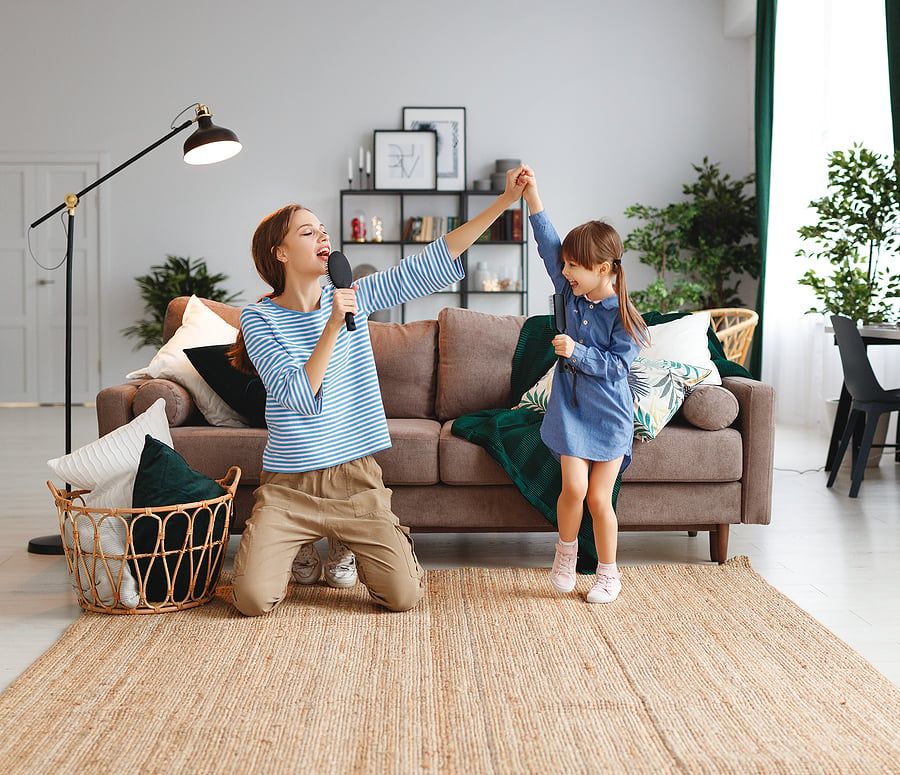
Fingerplays, on the other hand, are great for building the fine motor muscles in the fingers.
six. Listening Skills
Learning songs is a great listening activity. During an action vocal such every bit "If you lot're happy and you lot know it," kids need to listen for the actions, so they can perform them.
They also listen to the words of the vocal or listen for when the chorus is coming so they can bring together in.
All of these help develop listening skills, which are of import for coping at school and developing adept reading skills. It also helps build their concentration bridge.
7. Auditory Retentiveness
Listening to the words of songs and learning to sing them strengthens a child's auditory memory.
While immature toddlers start off remembering simple lyrics such as "twinkle, twinkle, lilliputian star", with time and practice they acquire to memorize longer, more circuitous verses.
Retentivity is a necessary skill for learning to read and tin be built easily with songs, rhymes, listening activities and retentiveness games.
8. Sequencing
Children must not merely learn to remember what they hear but also be able to recall information technology in sequence. This is likewise part of learning to read.
By singing songs, children are exposed to sequences such equally numbers increasing or decreasing in a counting song, or singing near a sequence of events.
These are a few examples of songs that incorporate a sequence of events:
- Miss Polly had a dolly
- Five fiddling ducks
- This piffling piggy
- Head, shoulders, knees and toes
- The ants go marching
- This sometime man
They often have to memorize a sequence of actions that aren't necessarily in a logical order – such as in the song "We're going on a bear hunt" or "If you're happy and y'all know information technology". This helps build sequential memory.
nine. Sound Patterns and Rhyming
The basis of learning to read and spell is to sympathise sound and to be able to hear sounds in words. This is part of a child's auditory perception.
A young infant has his ears trained over time to hear the sounds that are a function of his language.
When he is older, he can integrate audio with visual representations of audio (letters and words) and decode them to read and spell.
This makes singing an first-class pre-reading activity as you lot are developing a perception of sounds in your kids when you teach them songs.
Songs that have rhyming words, nonsense words and repetitive words are specially good for this.
Being exposed to rhyming words is one of the means children learn to hear patterns, a skill they will rely on when reading.
10. Confidence
Singing is a blithesome activity and one that gives kids a sense of competence. Information technology is difficult to "do information technology wrong" and so kids experience the activity as successful.
Immature kids need validation and they demand to feel that they are capable. Any activeness that a child feels she has succeeded in, boosts her self-confidence.
Singing as well teaches kids to use their voice, to be heard and to express themselves – all qualities that heave confidence. A child who is singing is being heard and acknowledged.

11. A Helpful Tool
Singing is the kind of activity that can be used in many helpful ways and in a diverseness of contexts.
Recollect about the role of singing when used as a way to calm down active children, or when you sing nursery rhymes about sleep as kids drift off at night.
Music can also be used to elevator the mood and get kids to be more than agile and involved, such as while singing a motility song.
Demand to motivate kids to tidy up? Sing some clean-up songs. What about teaching them to wash their hands properly? Apply a manus-washing song!
As you can see, singing is about so much more than just having fun.
Would you like a twelvemonth of done-for-you, x-infinitesimal activities to teach your 3-5-year-old through play? Get your copy of the Learning Through Play Activeness Pack for only $27.

Or shop for instantly downloadable and printable kids' activities and games. Go more info here.

Source: https://empoweredparents.co/benefits-of-singing-in-early-childhood/

Postar um comentário for "Why Singing and Chants Are Important With Learning to Read"