What Style of Martial Arts Did Bruce Lee Use
 The Jeet Kune Do Emblem | |
| Besides known as | JKD, Jun Fan Jeet Kune Practise[a] |
|---|---|
| Focus | Hybrid |
| Creator | Bruce Lee |
| Famous practitioners | (see notable practitioners) |
| Parenthood | Jun Fan Gung Fu: [b] Wing Chun,[2] [three] Battle,[4] [2] Fencing,[two] Escrima, Judo, Jujutsu,[5] Savate,[six] Traditional Taekwondo,[c] [seven] Tai Chi, Grab Wrestling[5] |
| Descendant arts | Not-Classical Gung Fu, Wing Chun Do, Emerson Combat Systems, Wei Kuen Do, Mixed Martial Arts (modernistic)[8] [9] [10] |
| Jeet Kune Practise | |||||||||||||||
|---|---|---|---|---|---|---|---|---|---|---|---|---|---|---|---|
| Chinese | 截拳道 | ||||||||||||||
| Literal meaning | "Way of the Intercepting Fist" | ||||||||||||||
| |||||||||||||||
Jeet Kune Exercise [d] is an eclectic martial arts philosophy heavily influenced and adapted past the personal philosophy and experiences of martial creative person Bruce Lee.
Overview and philosophy [edit]
Jeet Kune Do was conceived past Bruce Lee, based on his experiences in unarmed fighting and self-defence force. Originally, Lee had studied and researched various forms of martial arts and would formalize a system named Jun Fan Gung Fu [e] circa 1962. However, effectually 1964, post-obit his encounter with Wong Jack-man, Lee came to realize the error of binding oneself to a systematized martial fine art and denounced the Jun Fan Gung Fu.[11] [12] Following this, Lee began to passionately work on research and do in social club to refine his way of practicing martial arts. In 1965, he outlined the bones concept of Jeet Kune Do.[13]
Not wanting to create another style that would share the limitations that all styles had, he instead described the procedure which he used to create information technology:
I have not invented a "new manner," composite, modified or otherwise that is set inside distinct form as autonomously from "this" method or "that" method. On the reverse, I promise to free my followers from clinging to styles, patterns, or molds. Recollect that Jeet Kune Practice is merely a name used, a mirror in which to see "ourselves". . . Jeet Kune Practise is non an organized institution that one tin can be a fellow member of. Either you understand or you don't, and that is that. There is no mystery virtually my style. My movements are simple, direct, and not-classical. The extraordinary part of it lies in its simplicity. Every movement in Jeet Kune Do is being so of itself. In that location is nothing artificial about information technology. I e'er believe that the easy way is the correct mode. Jeet Kune Do is only the direct expression of 1's feelings with the minimum of movements and energy. The closer to the true way of Kung Fu, the less wastage of expression at that place is. Finally, a Jeet Kune Practice man who says Jeet Kune Do is exclusively Jeet Kune Do is simply non with information technology. He is still hung up on his cocky-closing resistance, in this example, anchored down to a reactionary pattern, and naturally is notwithstanding bound by another modified pattern and can motility within its limits. He has not digested the unproblematic fact that truth exists outside all molds; pattern and awareness is never exclusive. Over again let me remind you Jeet Kune Do is just a proper name used, a boat to go one across, and once across it is to exist discarded and non to be carried on 1's back.
—Bruce Lee[xiv]

Lee stated his concept does not add more and more than things on elevation of each other to form a system, but rather selects the best thereof. The metaphor Lee borrowed from Chan Buddhism was of constantly filling a loving cup with water, and so elimination information technology, used for describing Lee's philosophy of "casting off what is useless".[15]
Lee considered traditional form-based martial arts, that placed emphasis on pre-arranged patterns, forms and techniques to be restrictive and at worst, ineffective in dealing with cluttered self-defence force situations. Lee believed that real gainsay was live and dynamic.[xvi]
Jeet Kune Do was conceived to be dynamic, to enable its practitioners to adapt to the abiding changes and fluctuations of live combat. He believed these decisions should be made within the context of "real gainsay" and/or "all-out sparring" and that it was only in this surround that a practitioner could actually deem a technique worthy of adoption.[16]
Principles [edit]
Unlike more traditional martial arts, Jeet Kune Practise is not fixed or patterned and is a philosophy with guiding ideas. Named for the Fencing concept of interception or attacking when i's opponent is nearly to attack, Jeet Kune Practise's practitioners believe in minimal effort with maximum issue and extreme speed.[ citation needed ]
The following are principles that Lee incorporated into Jeet Kune Do.[17] He felt that universal gainsay truths were self-axiomatic, and would lead to combat success if followed. Familiarity with each of the "four ranges of combat", in particular, is thought to be instrumental in becoming a "total" martial artist.[ commendation needed ]
JKD believes the best defense is a strong criminal offence, hence the principle of an "intercepting fist". For someone to attack some other hand-to-mitt, the attacker must approach the target. This provides an opportunity for the targeted person to "intercept" the attacking motion. The principle of interception may be applied to more than intercepting the actual physical set on; non-verbal cues (subtle movements of which opponent may exist unaware) may also be perceived or "intercepted", and thus used to ane's advantage. The "five ways of attack", categories that aid JKD practitioners organize their fighting repertoire, comprise the offensive teachings of JKD. The concepts of "Finish hits & finish kicks," and "Simultaneous parrying & punching," based on the concept of single fluid motions that attack while defending (in systems such equally épée fencing and Wing Chun), etch JKD's defensive teachings. These were modified for unarmed gainsay and implemented into the JKD framework past Lee to complement the principle of interception.[ citation needed ]
Stance [edit]
Seen in many of his flick fight scenes such as in the Fashion of the Dragon where he fought against Chuck Norris, Bruce Lee fought in a side southpaw horse stance. His jabs and crosses came from his right manus and followed up with a lot of sidekicks. Instead of a mutual bank check seen in muay thai, Bruce uses an oblique leg kicking to block a potential kick. This technique is called the jeet tek ("finish kicking" or "intercepting boot").[18] He adopted other defensive concepts institute in many other systems such as slipping and rolling from Western boxing and forearm blocks found in Eastern martial arts such every bit Kung Fu.
Footwork [edit]
Lee's nimble and agile skipping-like footwork is seen in his movies. This technique was adopted from Muhammad Ali's footwork in his boxing stance.[19] This footwork tin be achieved from practice using a jump rope as jumping rope imitates this nimble, jumpy action that is a quick way to maneuver your fashion around and abroad from an enemy's strikes. The footwork too has its influences from fencing.[20]
Straight atomic number 82 [edit]
Lee felt that the straight lead was the most integral part of Jeet Kune Practice punching, proverb, "The leading directly punch is the backbone of all punching in Jeet Kune Do."[21] The straight lead is not a ability strike but a strike formulated for speed. It is believed that the straight lead should always be held loosely with a slight motion, as this adds to its speed and makes it more difficult to run across and block. The strike is believed to be not only the fastest punch in JKD, but too the most accurate. The speed is attributed to the fact that the fist is held out slightly making it closer to the target and its accurateness is gained from the punch being thrown straight forward from one's centerline. The lead should exist held and thrown loosely and easily, tightening only upon touch, adding to one's dial. The punch can be thrown from multiple angles and levels.[22] [ page needed ]
Non-telegraphed dial [edit]
Lee believed that explosive attacks, without telegraphing signs of intent, were well-nigh constructive. He argued that the attacks should catch the opponent off-guard, throwing them off balance and leaving them unable to defend against subsequent attacks. "The concept behind this is that when you initiate your punch without any forewarning, such equally tensing your shoulders or moving your pes or body, the opponent will non accept enough fourth dimension to react," Lee wrote.[23] The key is that one must keep one's trunk and arms loose, weaving one'southward artillery slightly and only becoming tense upon affect. Lee wanted no wind-upwardly movements or "get ready poses" to prelude whatever JKD attacks. He explained that whatever twitches or slight movements earlier striking should exist avoided as they will give the opponent signs or hints as to what is being planned and and then they will be able to strike get-go while one is preparing an set on. Consequently, the non-telegraphed movement is believed to exist an essential role of Jeet Kune Do philosophy.[21]
"Exist like water" [edit]
Lee emphasized that every situation, in fighting or in everyday life, is varied. To obtain victory, therefore, information technology is believed essential not to be rigid, simply to be fluid and adaptable to any situation. Lee compared it to existence like water, saying "Empty your mind, exist formless, shapeless, like water. If you put water into a cup, information technology becomes the loving cup. You put water into a bottle and information technology becomes the bottle. You put it in a teapot it becomes the teapot. Now water can catamenia, or it can crash. Exist water, my friend."[24] His theory behind this was that one must be able to office in any scenario ane is thrown into and should react appropriately. One should know when to speed up or slow down, when to expand and when to contract, and when to remain flowing and when to crash. It is the awareness that both life and fighting can be shapeless and ever-irresolute that allows one to be able to adapt to those changes instantaneously and bring forth the appropriate solution. Lee did non believe in styles and felt that every person and situation is dissimilar and not everyone fits into a mold; ane must remain flexible in guild to obtain new knowledge and victory in both life and gainsay. It is believed that ane must never become stagnant in the listen or method, e'er evolving and moving towards improving oneself.
Economy of movement [edit]
Jeet Kune Do seeks to be economical in time and motility, teaching that the simplest things work best, as in Wing Chun. The economic system of move is the principle by which JKD practitioners achieve:
- Efficiency: An set on that reaches its target in the to the lowest degree fourth dimension, with maximum force
- Directness: Doing what comes naturally in a disciplined way
- Simplicity: Thinking in an uncomplicated fashion; without ornament
This is meant to help a practitioner conserve both energy and time, two crucial components in a physical confrontation. Maximized strength seeks to stop the battle quickly due to the corporeality of impairment inflicted upon the opponent. Rapidity aims to attain the target before the opponent can react, which is half-beat faster timing, as taught in Wing Chun and Western boxing.[25] Learned techniques are utilized in JKD to apply these principles to a variety of situations.
Finish hits [edit]
"When the distance is wide, the attacking opponent requires some sort of preparation. Therefore, set on him on his preparation of attack. To reach me, y'all must move to me. Your set on offers me an opportunity to intercept you." This means intercepting an opponent's set on with an attack of one'due south own instead of only blocking it. It is for this concept Jeet Kune Do is named. JKD practitioners believe that this is the nearly difficult defensive skill to develop. This strategy is a feature of some traditional Chinese martial arts as Wing Chun, equally well as an essential component of European épée Fencing. Stop hits and kicks utilize the principle of economic system of motion past combining assault and defense into i movement, thus minimizing the "time" element.[26]
Simultaneous parrying and punching [edit]
When confronting an incoming assault, the assail is parried or deflected, and a counterattack is delivered simultaneously. This is not as advanced equally a stop hit only more effective than blocking and counterattacking in sequence. Practiced in some Chinese martial arts such as Wing Chun, information technology is also known in Krav Maga every bit "bursting". Simultaneous parrying and punching apply the principle of economy of move by combining assail and defense into one movement, thus minimizing the "fourth dimension" element and maximizing the "energy" element. Efficiency is gained by utilizing a parry rather than a block. By definition, a "block" stops an assault, whereas a parry merely re-directs it. Redirection has two advantages, it requires less energy to execute and utilizes an opponent'southward energy confronting him past creating an imbalance. Efficiency is gained in that an opponent has less fourth dimension to react to an incoming assault, since he is notwithstanding withdrawing from his assault.
Low kicks [edit]
JKD practitioners believe they should direct their kicks, equally in Fly Chun, to their opponent'due south shins, knees, thighs, and midsection. These targets are the closest to the anxiety, provide more stability and are more difficult to defend against. Maintaining low kicks utilizes the principle of economic system of motion by reducing the distance a kick must travel, thus minimizing the "time" element. However, as with all other JKD principles naught is set in stone. In a typical JKD way, if a target of opportunity presents itself, fifty-fifty a target above the waist, ane could take advantage and non exist hampered by this principle.
Three ranges of combat [edit]
- Long
- Medium
- Close
Jeet Kune Do students train in each of the same ranges as. According to Lee, this range of training serves to differentiate JKD from other martial arts. He stated that well-nigh but not all traditional martial arts systems specialize in training at one or ii ranges. His theories have been peculiarly influential and substantiated in the field of mixed martial arts, as the MMA Phases of Combat are essentially the same concept as the JKD gainsay ranges.
Equally a historic annotation, the ranges in JKD have evolved over time. Initially the ranges were categorized as short or close, medium, and long range.[16] These terms proved cryptic and some instructors eventually evolved into their more than descriptive forms, although in that location is a lot of disagreement on whether or non this is right. Many believe that the 3 ranges equally described above are correct every bit distance to a target doesn't dictate what 'tools' tin be used. For instance,in close range, one can still kick, in improver to punching, grappling, trapping etc. To rename 'close range' the trapping or even grappling range is conditioning the practitioner in believing that is all that should exist done in that item range. [27] So for this reason many yet prefer these original iii categories.
5 ways of assault [edit]
JKD's original v ways of attack are:
- Simple Angular Attack or Simple Straight Attack (SDA or SAA)
- Set on Past Combination (ABC)
- Progressive Indirect Assault (PIA)
- Immobilization Attacks (IA)
- Attack By Cartoon (ABD)
Centerline [edit]


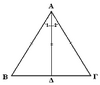
The centerline tin be expressed as the meridian of a triangle.
The centerline is an imaginary line fatigued vertically along the center of a standing human body, and refers to the infinite directly in front of that body. If one draws an isosceles triangle on the floor, for which ane's trunk forms the base of operations, and one's artillery form the equal legs of the triangle, then h (the top of the triangle) is the centerline. The Wing Chun concept is to exploit, command and dominate an opponent's centerline. All attacks, defenses, and footwork are designed to guard ane's own centerline while entering the opponent'due south centerline space. Lee incorporated this theory into JKD from his Sifu Ip Man'southward Wing Chun.[28] [ cocky-published source ]
The 3 guidelines for the centerline are:
- The one who controls the centerline will control the fight.
- Protect and maintain your own centerline while you control and exploit your opponent'due south.
- Control the centerline by occupying it.
This notion is closely related to maintaining control of the center squares in the strategic game chess. The concept is naturally present in xiangqi (Chinese chess), where an "X" is drawn on the game lath, in front of both players' full general and advisors.[28]
Combat realism [edit]
One of the premises that Lee incorporated in Jeet Kune Practice was "gainsay realism." He insisted that martial arts techniques should be incorporated based upon their effectiveness in existent gainsay situations. This would differentiate it from other systems where at that place was an emphasis on "flowery technique", as Lee would put information technology.[29] He claimed that flashy "flowery techniques" would arguably "look adept" only were oftentimes not applied or would prove ineffective in street survival and cocky-defense situations.[ citation needed ] This premise would differentiate JKD from other "sport"-oriented martial arts systems that were geared towards "tournament" or "point systems" (traditional martial fine art). Lee felt that these systems were "bogus" and fooled their practitioners into a false sense of true martial skill. He felt that considering these systems incorporated too many rule sets that would ultimately handicap a practitioner in self-defence situations and that these approaches to martial arts became a "game of tag" leading to bad habits such every bit pulling punches and other attacks; this would again pb to negative consequences in existent-world situations.[xxx] [ self-published source ]
Some other aspect of realistic martial arts training fundamental to JKD is what Lee referred to equally "Aliveness". This is the concept of training techniques with an unwilling assistant who offers resistance. He fabricated a reference to this concept in his famous quote "Boards don't hit dorsum!" Because of this perspective of realism and aliveness, Lee utilized rubber gear from various other contact sports to allow him to spar with opponents "full out". This arroyo to training allowed practitioners to come up as close as possible to existent combat situations with a loftier degree of safety.
Workout [edit]
To keep up with the demand of Jeet Kune Do combat, the practitioner must status his trunk. Some exercises Lee did included Da Sam Sing or Gak Sam Sing which is a traditional method of forearm conditioning proficient in Classical Kung Fu. He as well did exercises simulating a fight against a 4-limbed human being using the traditional Mook Yan Jong (Cantonese) used in Wing Chun.
Bruce Lee was an avid follower of wrestler Bully Gama's grooming routine. He read articles about him and how he employed his exercises to build his legendary strength for wrestling, rapidly incorporating them into his own routine. The preparation routines Lee used included isometrics as well as "the true cat stretch", "the squat" (known as "baithak"), and also known as the "deep-articulatio genus bend."[31]
Notable practitioners [edit]
- Bruce Lee (founder)
- Alex Caceres
- Anthony Arnett
- Brandon Lee
- Dan Inosanto
- Danny Chan
- Diana Lee Inosanto
- Dave Leduc
- Erik Paulson
- Ernest Emerson[32] [33]
- Glenn Danzig[34] [35]
- James Wilks
- Jang Hyuk
- Jason David Frank
- Jeff Imada
- Jerry Poteet
- Joe Lewis
- Kareem Abdul-Jabbar
- Nicolas Cage[ citation needed ]
- Patrick Marcil
- Richard Bustillo
- Ron Balicki
- Shannon Lee
- Taimak
- Ted Wong
- Tim Tackett
- Yorinaga Nakamura
Run into as well [edit]
- Kajukenbo
- Tao of Jeet Kune Practice
- Bruce Lee's Fighting Method
Notes [edit]
- ^ On Jan x, 1996, the Bruce Lee Foundation decided to use the name Jun Fan Jeet Kune Exercise ( 振藩截拳道 ) to refer to the martial arts organisation which Lee founded; Jun-fan being Lee's Chinese given name.
- ^ This refers to knowledge when Bruce Lee promoted his early concretized system, before abandoning it and embracing inconcrete progressive development of 1's fighting ability by philosophy of Jeet Kune Do. Some knowledge from Jun Fan Gung-Fu is nevertheless used in mod JKD instruction.
- ^ Martial arts practised in Korea during the 1940s and 1950s by the nine original kwans, or martial arts schools, before formation of Korea Taekwondo Association. In Bruce Lee's case, he learned various Traditional Taekwondo from diverse people. Most notable existence Jhoon Goo Rhee of Chung Do Kwan style.
- ^ (Chinese: 截拳道 ; Cantonese Yale: jiht kyùhn douh; [tsìːt̚.kʰy̏ːn.tòu]), or "The way of the intercepting fist" in Cantonese, abbreviated JKD
- ^ As in Gung Fu of Jun-fan, which was Bruce Lee'south birthname.
References [edit]
- ^ Bruce Lee: Dynamic Becoming, p.23
- ^ a b c Black Chugalug Magazine, November 1967 issue, pages 14-20 https://books.google.fi/books?id=RM4DAAAAMBAJ&pg=PA14&dq=black+belt+magazine+kato+jeet+kune+do&hl=fi&sa=X&ved=2ahUKEwiKi_m8177vAhUkpIsKHeFbDrAQ6AEwAXoECAIQAg#five=onepage&q&f=false
- ^ Black Chugalug: Bruce Lee Collector's Edition Summertime 1993
- ^ Bruce Thomas (1994). Bruce Lee: Fighting Spirit : a Biography . Frog Books. pp. 11–. ISBN978-one-883319-25-0.
- ^ a b Polly, Matthew (2018). Bruce Lee: A Life. New York: Simon & Schuster. ISBN 9781501187643.
- ^ Championship: Bruce Lee - Between Wing Chun and Jeet Kune Exercise, Author: Jesse Glover, Publisher: Glover Publications (January i, 1976) ISBN 0-9602328-0-10 ISBN 978-0-9602328-0-2.
- ^ Nilsson, Thomas (May 1996). "With Bruce Lee: Taekwondo Pioneer Jhoon Rhee Recounts His 10-Year Friendship With the "Dragon"". Black Belt Magazine. 34 (5): 39–43. Retrieved November 19, 2009.
- ^ Bruce Lee's Protégé Recalls His Humility Amid 'Once Upon a Fourth dimension' Criticism Archived August 16, 2019, at the Wayback Machine. Diverseness. July 31, 2019.
- ^ Dana White and the futurity of UFC Archived Oct 7, 2018, at the Wayback Machine. Fight Times. October 1, 2004.
- ^ Stets, Michael (July xx, 2013). "The MMA World Pays Tribute to Bruce Lee 40 Years Later His Death". Bleacher Report. Archived from the original on June 19, 2020. Retrieved June 15, 2020.
- ^ Dorgan, Michael. Bruce Lee's Toughest Fight, 1980 July. Official Karate
- ^ Rossen, Jake (August 10, 2015). "Bruce Lee: The Time Bruce Lee Was Challenged to a Real Fight". Mental Floss. New York. Archived from the original on July xi, 2016. Retrieved July 10, 2016.
- ^ https://www.blurb.com/b/10483726-original-jeet-kune-do-quarterly-magazine-issue-11 "Exclusive Interview Original Bruce Lee Student James French"
- ^ Lee, Bruce (September 1971), "Liberate Yourself From Classical Karate", Black Belt Magazine, Rainbow Publications, Inc., vol. 9, no. 9, p. 24.
- ^ Pollard, Maxwell (November 1967). In Kato'southward Gung-fu Action is Instant. Black chugalug magazine. pp. 14–20.
- ^ a b c Lee, Linda (1975), The Tao of Jeet Kune Do, Ohara Publications Inc., ISBN0-89750-048-2
- ^ Hochheim, W. Hoch (January 1995), "The Maze of Jeet Kune Exercise", Black Belt Magazine, Rainbow Publications, vol. 33, no. 1, p. 110
- ^ Instructors Confidential Transmission Supplemental Handbook. Dorrance Publishing. p. 98. ISBN978-i-4349-4062-9.
- ^ Vaughn, Jack; Lee, Mike, eds. (1986). The Legendary Bruce Lee. Black Belt Communications. p. 127. ISBN978-0-89750-106-4.
- ^ admin, Author (March nineteen, 2019). "Bruce Lee Footwork and Muay Thai". Learn and Train Muay Thai and Martial Arts without Access to a Gym or Instructors . Retrieved April 27, 2021.
- ^ a b Lee, Bruce (2011). Tao of Jeet Kune Exercise. Valencia: Black Chugalug.
- ^ Lee, Bruce (2008). Bruce Lee's Fighting Method. Valencia: Black Chugalug.
- ^ Lee, Bruce (1975). The Tao of Jeet Kune Exercise . Ohara Publications. p. 14. ISBN0897502027.
- ^ Lee, Bruce (1966). Pierre Barton Testify. Hong Kong: Pierre Barton.
- ^ Chu, Robert (September 1991). "The Wing Chun Mind: Learn to Think Like a True Fighter". hawkinscheung.com. Within Kung Fu. Archived from the original on sixteen February 2013.
- ^ Cheng, David (July xv, 2004). Jeet Kune Do Basics. Tuttle Publishing. p. 146. ISBN978-0-8048-3542-8.
- ^ "Fighting Ranges of Jeet Kune Do, Part 1". December 9, 2013. Archived from the original on January 14, 2020. Retrieved November 24, 2018.
- ^ a b Argyridis, Panayiotis (Oct 12, 2010). The Principles Theories and Practice of Jun Fan Gung Fu/Jeet Kune Practise Vol.i. Xlibris Corporation. pp. 120–122. ISBN978-1-4535-0635-half-dozen. [ self-published source ]
- ^ Stone, Zofia (March i, 2017). Bruce Lee: A Biography. Vij Books India Pvt Ltd. ISBN9789386367280.
- ^ David; Lumsden, Kevin (June 23, 2010). The Iron Dragon: Richard Bustillo. Xlibris Corporation. p. 193. ISBN978-one-4535-1025-iv. [ cocky-published source ]
- ^ Little, John, Bruce Lee – The Art of Expressing The Man Body (Tuttle Publishing, 1998), p. 58
- ^ Combs, Roger (2004), "Emerson Knives", Knives Illustrated, 18 (2): 36–41, 65–69
- ^ Emerson, Ernie (2006e). "IMB Academy News". IMB Academy. Archived from the original on July 4, 2007. Retrieved February xx, 2007.
I outset met Richard Bustillo as a fledgling student at the Filipino KALI Academy in Torrance, California in the 1970s. I had moved from Northern Wisconsin just to train at what was at the time the merely full-contact fighting school in the world. This was a fighter'south schoolhouse and needless to say I was more than a little intimidated at our first encounter. After all, hither I was in a schoolhouse filled with some of Bruce Lee's original equipment in front end of someone who had trained with Bruce.
- ^ "Glenn Danzig Satan's Child". the7thhouse.com. November ten, 1999. Archived from the original on July 5, 2008. Retrieved Oct 9, 2009.
- ^ "Glenn Danzig trained in Jeet Kune Practise by Bruce Lee". YouTube. 1992. Archived from the original on May xiii, 2013. Retrieved August 23, 2007.
Bibliography [edit]
- Assli, Salem (2002). Jeet Kune Do 'Toutes les techniques de Bruce Lee' . Editions Chiron. ISBN2-7027-0693-two.
- Balicki, Ron; Steve Gold (2001), Jeet Kune Practice: The Principles of a Complete Fighter , HNL Publishing, ISBN0-9531766-3-0
- Beasley, Jerry (2001), The Jeet Kune Do Experience: Understanding Bruce Lee's Ultimate Martial Fine art, Paladin Printing, ISBN978-one-58160-131-2
- Bishop, James (2004), Bruce Lee: Dynamic Becoming, Dallas: Promethean Printing, ISBN0-9734054-0-half-dozen
- Cheng, David (2004), Jeet Kune Do Basics, Tuttle Publishing, ISBN0-8048-3542-Ten
- Davis, Lamar (2001), Jun Fan/Jeet Kune Practise: Scientific Streetfighting, HNL Publishing, ISBN978-0-9531766-1-8
- Heath, Adam (2011), Mixed Martial Arts' About Wanted: The Top 10 Book of Crazy Combat, Bully Grappling, and Ill Submissions, Potomac Books Inc., ISBN978-1597975490
- Hochheim, Due west. Hoch (January 1995), "The Maze of Jeet Kune Practice", Blackness Belt Magazine, Rainbow Publications, Inc., vol. 33, no. 1
- Kent, Tackett, Chris, Tim (1989), Jun Fan Jeet Kune Do: The Textbook, Activeness Pursuit Group, ISBN0-86568-131-7
- Lee, Bruce (1975), Tao of Jeet Kune Exercise, Ohara Publications, ISBN978-0-89750-048-7
- Lee, Bruce (1978), Bruce Lee's Fighting Method, Ohara Publications, Inc., ISBN0-89750-062-8
- Little, John (1996), The Warrior Within: The Philosophies of Bruce Lee to Better Understand the Globe Effectually Yous and Attain a Rewarding Life, McGraw-Colina, ISBN0-8092-3194-8
- Little, John (1997), Jeet Kune Do: Bruce Lee'due south Commentaries on the Martial Style, Tuttle Publishing, ISBN0-8048-3132-7
- Petty, John (2001), Bruce Lee: Artist of Life, Tuttle Publishing, ISBN0-8048-3263-3
- Piffling, John (2002), Hit Thoughts: Bruce Lee'southward Wisdom for Daily Living, Tuttle Publishing, ISBN0-8048-3471-vii
- Seaman, Kevin (1999), Jun Fan Gung Fu Seeking The Path of Jeet Kune Do, South.l.: Wellness 'N' Life, ISBN0-9531766-2-2
- Thomas, Bruce (1994), Bruce Lee: Fighting Spirit, Berkeley, California: Frog, Ltd., ISBN1-883319-25-0
- Yılmaz, Yüksel (2000), Dövüş Sanatlarının Temel İlkeleri, İstanbul, Turkey: Beyaz Yayınları, ISBN975-8261-87-8
- Yılmaz, Yüksel (2008), Jeet Kune Do'nun Felsefesi, İstanbul, Turkey: Yalın Yayıncılık, ISBN978-9944-313-67-4
External links [edit]
- Bruce Lee's Fighting Method on Internet Archive
- Tao of Jeet Kune Exercise on Internet Archive
Source: https://en.wikipedia.org/wiki/Jeet_Kune_Do

Postar um comentário for "What Style of Martial Arts Did Bruce Lee Use"